

Grow GuideKnowledge
Far-Red Light in Vertical Farming: Why This Wavelength Range Significantly Boosts Yield
Far-Red light (700–750 nm), long dismissed as inefficient for photosynthesis, is now recognized as a key driver of plant growth in vertical farming. Combined with red light, it triggers the Emerson Enhancement Effect and influences phytochrome activity, leading to larger leaf area, more biomass, and higher yields — without additional energy input. Because Far-Red has different effects in early vs. late growth phases, it must be dynamically controlled. Conventional LEDs with fixed spectra miss th
This note is no longer available. All notes
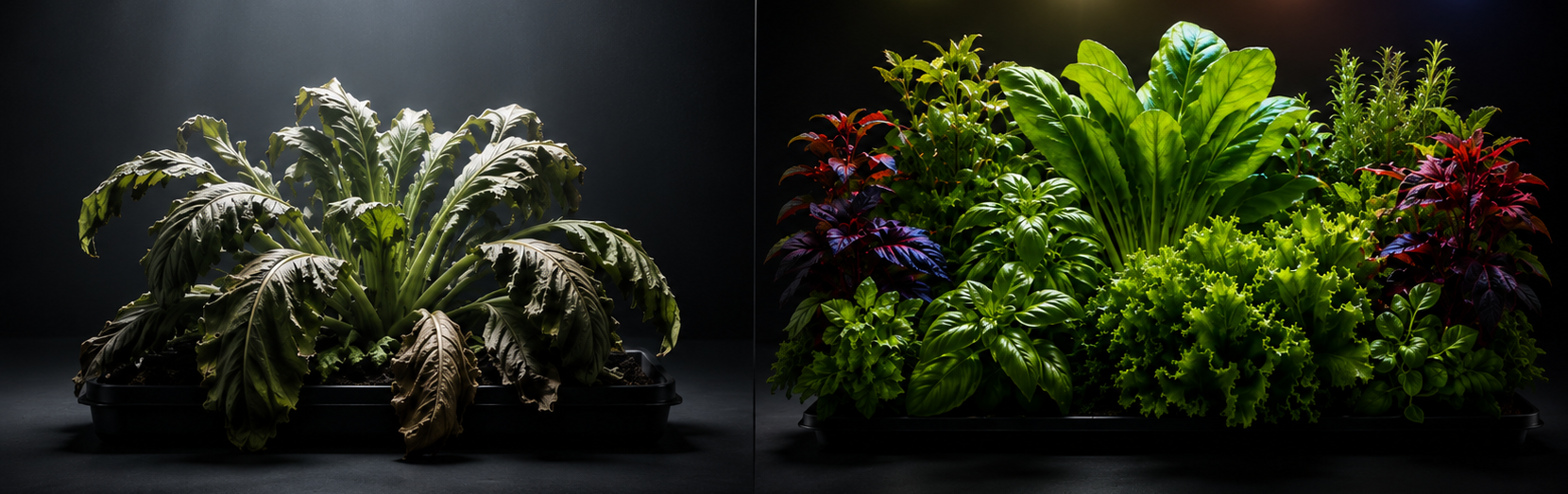
Far-Red light activates growth signals in plants and enables higher biomass with the same energy input.
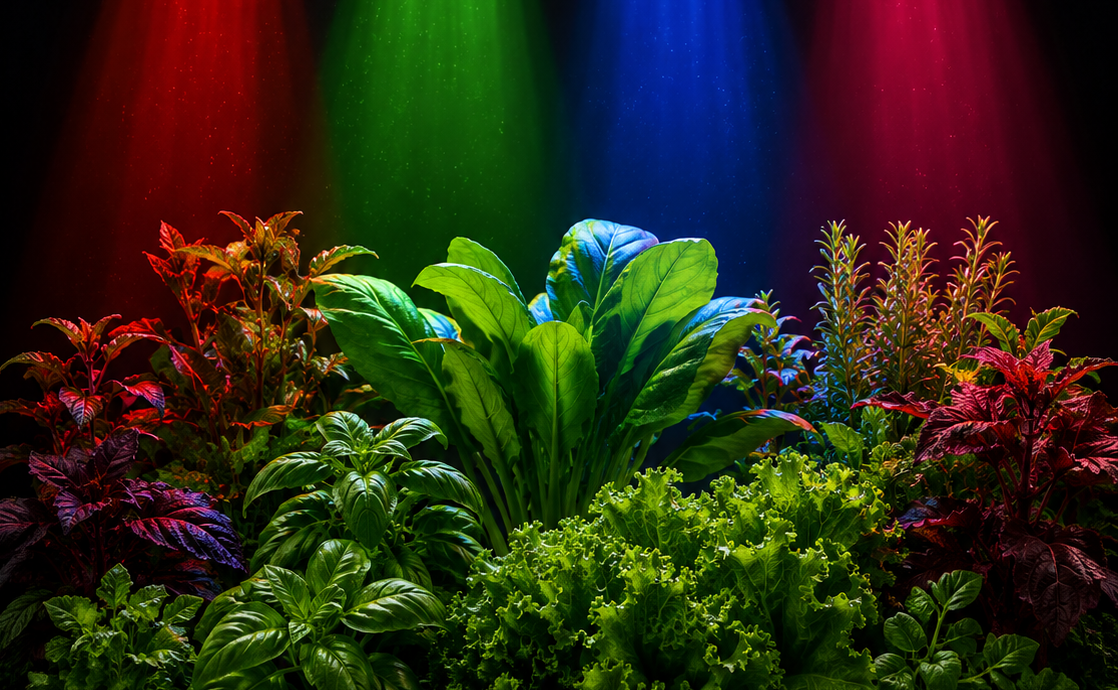
In vertical farming, the focus has long been on blue and red light. These two spectral ranges are considered central to photosynthesis and plant structure. However, more recent scientific findings show that a third range is crucial: Far-Red light.
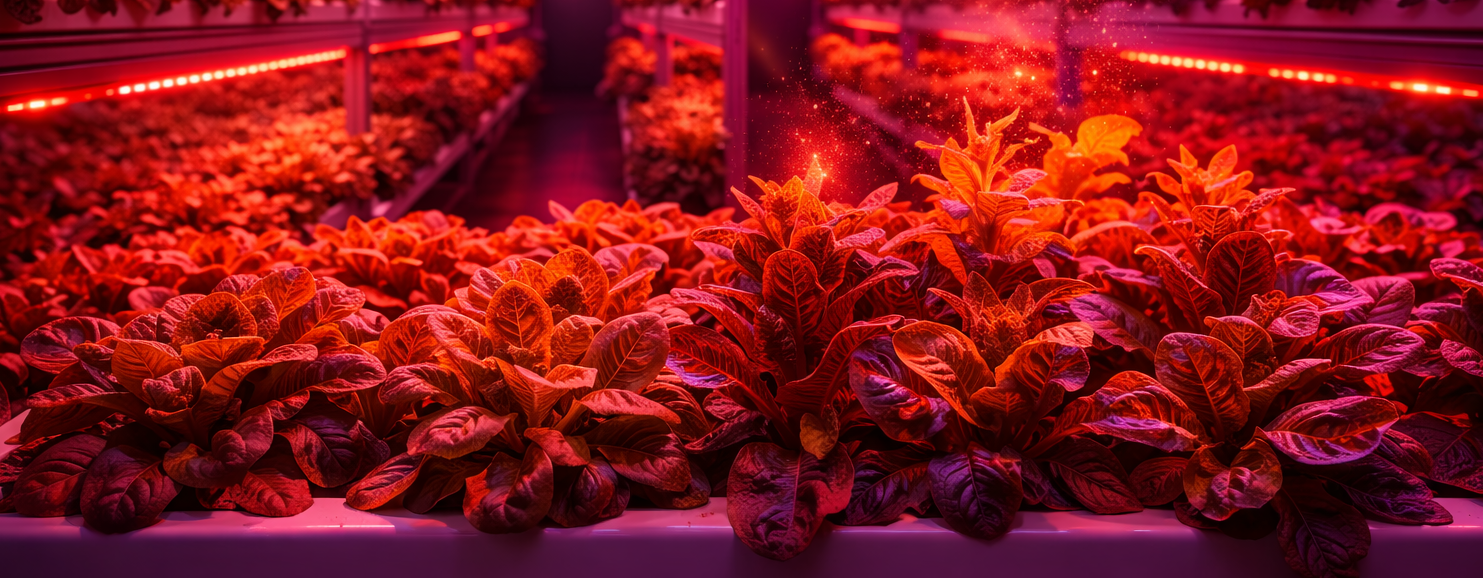
Far-Red describes light in the wavelength range of approximately 700 to 750 nanometers. For a long time, this range was considered inefficient because it lies outside the classic photosynthesis curve. This assumption is now considered outdated.
Studies show that Far-Red, in combination with red light, can increase photosynthetic performance. This effect is known as the Emerson Enhancement Effect. As a result, plants are able to extract more energy from the same light spectrum.
In addition, Far-Red influences what is known as phytochrome activity. This plant sensor system controls how plants perceive their environment. When the Far-Red share is increased, plants respond with enhanced growth, larger leaf area, and higher biomass production.
In practice, this means: Targeted use of Far-Red can significantly increase yield without requiring more energy input. This is precisely where the difference between classic grow lights and modern systems becomes apparent. Most conventional LED solutions work with fixed spectra and offer either no Far-Red component at all or only a minimal one. As a result, a key growth lever remains untapped.
Modern lighting systems with individually controllable channels, on the other hand, make it possible to use Far-Red in a targeted way — and, above all, to regulate it dynamically.
This is decisive, because Far-Red does not act the same way in every phase:
- In early growth phases, too high a share can lead to undesirable stretching
- In later phases, it can be deployed specifically to increase yield
Only systems with controllable spectra can deliver this fine-tuned control.
This is exactly where PlantaeLight comes in. By enabling individual color channels to be controlled independently of each other, the light spectrum can be precisely adapted to the plant, growth phase, and production goal.
The result is not only a higher yield, but also significantly better energy efficiency.
The research is clear: Far-Red is not an optional add-on — it is a decisive factor for modern vertical farming.
Sources:
https://www.sciencedirect.com/science/article/pii/S0304423824004230